Property Valuation Calculator — South Africa
Estimate what a rental property is worth using the income capitalisation method, and check it against the asking price.
Quick answer: Value = Net Operating Income ÷ Capitalisation Rate. Take annual rent after vacancy and operating costs, divide by a cap rate of roughly 4–6% for well-located SA residential property (SA Property Tools benchmark, based on typical local net rental yields, 2026), and you get an income-based estimate of what the property is worth to an investor.
Property Valuation Calculator
Income capitalisation method · NOI ÷ cap rate
How to Use This Calculator
Enter the monthly rental income the property earns or could realistically earn, then add vacancy, managing agent fee, rates, levies, maintenance and insurance — the same cost categories used in our Rental Yield Calculator. Select a capitalisation rate: lower for premium, low-risk suburbs where investors accept a lower return, higher for higher-yield, higher-risk areas.
If you are evaluating a specific listing, enter the asking price to see whether it is in line with, above, or below what the rental income alone justifies at your chosen cap rate. Enter the property's size in m² to also see the implied price per square metre.
What Is Property Valuation?
Property valuation is the process of estimating what a property is worth. In South Africa, three methods are recognised: the sales comparison approach (comparing recent sales of similar nearby properties), the income capitalisation approach (valuing a property based on the income it produces) and the cost approach (what it would cost to buy the land and rebuild, less depreciation). This calculator uses the income capitalisation approach — the standard method for valuing a rental property as an investment, and the one most directly useful to a buy-to-let investor deciding whether a purchase price is justified by the rent it can generate.
Unlike our Rental Yield Calculator, which takes a known purchase price and works out the resulting yield, this tool works in the opposite direction — it takes the rental income and works out what price that income actually supports. Used together, the two tools let you check a listing from both directions: does the asking price produce an acceptable yield, and does the rental income justify the asking price?
The Income Capitalisation Method Explained
Effective annual income = Monthly rent × (1 − vacancy%) × 12
Annual operating costs = (management fee + rates + levies + maintenance + insurance) × 12
Net Operating Income (NOI) = Effective annual income − annual operating costs
Estimated Value = NOI ÷ Capitalisation Rate
Net operating income excludes bond repayments — the method values the property itself, independent of how any particular buyer chooses to finance it. The capitalisation rate reflects the return an investor expects for the risk and location: a lower cap rate implies a higher value for the same income, because investors accept a lower return in a more desirable, lower-risk suburb. A higher cap rate implies a lower value for the same income, reflecting higher perceived risk or a less desirable area. This calculator uses the same 4–6% net-yield range already established as typical for well-located South African buy-to-let property on our Rental Yield Calculator, applied here as the capitalisation rate.
Income Capitalisation Value at Different Rent Levels
| Monthly Rent | Illustrative Annual NOI | Value @ 4% Cap | Value @ 5% Cap | Value @ 6% Cap |
|---|---|---|---|---|
| R 10,000 | R 84,000 | R 2,100,000 | R 1,680,000 | R 1,400,000 |
| R 15,000 | R 126,000 | R 3,150,000 | R 2,520,000 | R 2,100,000 |
| R 20,000 | R 168,000 | R 4,200,000 | R 3,360,000 | R 2,800,000 |
| R 25,000 | R 210,000 | R 5,250,000 | R 4,200,000 | R 3,500,000 |
Illustrative NOI assumes 70% of gross annual rent is retained after vacancy and typical operating costs combined — use the calculator above with your own actual costs for a precise figure.
Other Property Valuation Methods Used in South Africa
The sales comparison approach looks at recent sales of similar properties nearby, adjusted for differences in size, condition and features — this is what an estate agent's Comparative Market Analysis (CMA) is built on, and it is the most common method for valuing a primary residence rather than a rental investment. The cost approach calculates what it would cost to buy the land and rebuild the structure at current construction rates, less depreciation for age and condition — our Building Cost Estimator (see the Developer Tools section) can help model the rebuild-cost side of this approach. A simpler shortcut some buyers use is price per square metre — comparing a property's asking price per m² against recent comparable sales in the same suburb, which this calculator also shows if you enter the property's size.
Municipal Value vs Market Value
Your property's municipal value (set by the municipality's general valuation roll, typically revalued every 4–5 years) is used purely to calculate your monthly rates bill — it is not the same as market value and is often lower than what a buyer would actually pay. Confirm your municipal value on your rates account or your metro's online valuation roll portal, and see our Municipal Rates Calculator to convert it into an estimated monthly rates figure. Market value — what a willing buyer would actually pay a willing seller — is what both the income capitalisation and sales comparison methods aim to estimate, and is the figure relevant when buying, selling or financing a property.
How Much Does a Property Valuation Cost in South Africa?
A bank valuation for bond purposes typically costs R3,000–R6,000, usually built into your bond application costs rather than paid separately. Independent registered valuers set their own fees on a sliding scale based on property value and the complexity of the work — the South African Council for the Property Valuers Profession (SACPVP) has not published a fixed fee guideline since 2010, so get a direct quote for anything beyond a bank or municipal valuation. Under the Property Valuers Profession Act, only SACPVP-registered valuers may practise professionally — check registration before commissioning a formal valuation report for legal, estate or CGT base-cost purposes.
A Worked Example
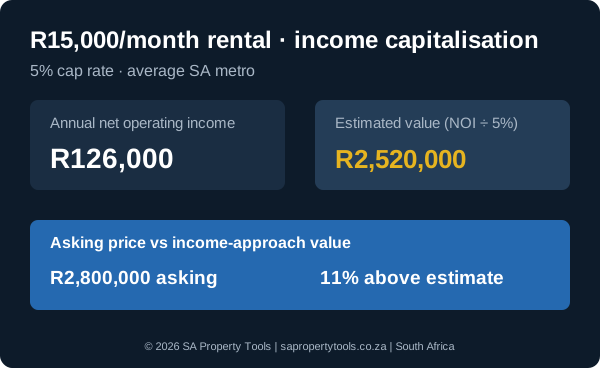
A 2-bedroom apartment renting for R15,000 per month has an illustrative annual net operating income of approximately R126,000 after typical vacancy and operating costs (roughly 70% of gross annual rent retained). At a 5% capitalisation rate — typical for an average South African metro — the income approach estimates the property's investment value at R126,000 ÷ 0.05 = R2,520,000. If the seller is asking R2,800,000, the property is priced approximately 11% above what its rental income alone would justify at that cap rate — worth negotiating on, checking against comparable sales, or reassessing at a more conservative cap rate for the area before committing.