Building Cost Calculator, South Africa
Estimate residential construction costs across all 9 provinces. Adjust for build type and finish level. Based on 2026 provincial data.
Quick answer: South African residential building costs for a standard mid-range finish range from around R9,100/m² in North West to the Western Cape's R14,800 to R17,000/m², with Gauteng at approximately R15,000/m² (2026 rates). Figures cover labour and materials for the whole building at a standard mid-range finish, excluding land, professional fees and municipal connections.
Building Cost Estimator
Enter Your Project Details
⚠️ For planning purposes only, not a quote. Consult a registered quantity surveyor or contractor for accurate project pricing.
How to Use This Calculator
- Enter floor areaEnter your floor area in square metres. This is the gross floor area including all rooms, walls and any covered areas like a garage or veranda.
- Select provinceSelect your province. This applies the local average 2026 construction rate per m² for that province.
- Select build typeChoose new build, extension or addition, or renovation. Extensions cost about 15% more due to tie-in complexity.
- Select finish levelChoose basic or economy, standard or mid-range, or high-end or luxury finish.
- Click CalculateResults show a low, mid and high cost estimate, your adjusted rate per m² and a 10% contingency figure. Add professional fees and municipal connections separately for your full project budget.
Building Costs Per Square Metre in South Africa: 2026 Guide
Understanding building costs per square metre is the first step in planning any construction project in South Africa. Whether you are building a new family home, adding a granny flat or extending your kitchen, the cost per m² benchmark is the figure contractors, quantity surveyors and banks use to set budgets and assess loan applications. If you don't yet know your maximum floor area, check it against your zoning certificate's coverage and FAR figures with the Floor Area Ratio Calculator before costing a design that zoning won't actually allow.
2026 Building Cost Per Province
Construction costs differ significantly across South Africa's nine provinces. The primary drivers are local labour rates, the cost of transporting materials to site and the level of competition among contractors in each region.
| Province | Avg Cost / m² (Standard) | Typical 150m² Home | Relative Cost |
|---|---|---|---|
| Western Cape | R14,800 to R17,000 | R2,220,000 to R2,550,000 | Very High |
| KwaZulu-Natal | R16,700 | R2,505,000 | Very High |
| Gauteng | R15,000 | R2,250,000 | High |
| Free State | R12,700 | R1,905,000 | Mid-High |
| Eastern Cape | R12,300 | R1,845,000 | Mid |
| Northern Cape | R11,800 | R1,770,000 | Mid |
| Mpumalanga | R10,400 | R1,560,000 | Below Avg |
| Limpopo | R9,600 | R1,440,000 | Low |
| North West | R9,100 | R1,365,000 | Lowest |
Source: ooba, citing luxliveproperty; the Western Cape range is our estimate through local builders. Rates are for standard mid-range residential construction. Actual costs vary by site conditions, design complexity, contractor and materials specification.
How the Building Cost Formula Works
The base cost per square metre is a provincial average for standard mid-range residential construction. This calculator applies two adjustments, build type and finish level, to produce a more accurate estimate for your specific project.
Base Estimate = Floor Area (m²) × Provincial Rate (R/m²)
Adjusted Estimate = Base Estimate × Build Type Factor × Finish Level Factor
Low Estimate = Adjusted Estimate × 0.85
High Estimate = Adjusted Estimate × 1.15
Contingency = Adjusted Estimate × 0.10
Build Type Factors
- New Build (×1.00). Standard rate. A clean-slate construction on a prepared site with no existing structure constraints.
- Extension / Addition (×1.15). Additions typically cost 10–15% more per m² than new builds due to tie-in complexity, potential demolition and waterproofing requirements at the junction.
- Renovation (×0.75). Refurbishment of existing spaces is typically 20–30% cheaper per m² than new construction because the structure already exists. Full gut renovations involving rewiring or structural changes can approach new-build rates.
Finish Level Factors
- Basic / Economy (×0.75). Ceramic tiles, stock kitchen and bathroom units, standard paint, basic plumbing fixtures. Common for rental property or first homes on tight budgets.
- Standard / Mid-Range (×1.00). Porcelain tiles, mid-range kitchen and bathroom fittings, aluminium windows and doors. Most common for family homes and investment properties.
- High-End / Luxury (×1.50). Imported stone surfaces, custom cabinetry, underfloor heating, large-format tiles, aluminium stacking doors, high-specification plumbing fixtures.
What the Building Cost Per m² Does NOT Include
This is where many first-time builders get caught off-guard. The construction cost per square metre covers labour and materials for the whole building at a standard mid-range finish. Your total project budget must also account for:
- Land. The purchase price of the stand or erf is entirely separate.
- Professional fees. ooba puts the architect at up to 8% of the construction cost, the land surveyor at up to 5%, the structural engineer at about 2% and the quantity surveyor at up to 4%, so up to about 19% if all four are appointed (our estimate from ooba's 2026 fee figures).
- NHBRC enrolment. Required for new residential projects. Fees are calculated on build cost.
- Municipal plan approval. Building plan submission and approval fees vary by municipality.
- Site preparation. Clearing, levelling and bulk earthworks are typically not included in the m² rate.
- Municipal connection fees. New water, electricity and sewerage connections can cost R30,000–R150,000+ depending on municipality.
- Landscaping and paving. Gardens, driveways, boundary walls and retaining walls are outside the m² rate.
- VAT. If your contractor is VAT-registered, add 15% to the construction cost.
As a rough total project budget guide, add 30–40% on top of the pure construction cost to account for professional fees, connections and the unexpected.
Why Do Building Costs Vary So Much?
Building costs vary by up to 87% across South Africa's provinces, from R9,100/m² in North West (ooba's figures, citing luxliveproperty) to the Western Cape's R14,800 to R17,000/m². For the Western Cape we estimated the figures to be between R14,800 and R17,000 per m² through local builders. The calculator uses the upper figure for the Western Cape. The gap comes down to three factors: local labour rates, material transport costs to remote sites, and how much competition exists among contractors in each region.
Labour costs are significantly higher in the Western Cape due to a stronger local economy, which pushes up tradesperson day rates. Material transport costs are a major factor in remote provinces. Getting cement, steel and fittings to a rural Limpopo site costs more than delivering to a Johannesburg suburb. Local competition among contractors also plays a role.
Urban areas within any province typically cost 15–20% more than equivalent rural projects due to higher land values, logistics constraints on site and higher artisan day rates. A contingency of 10–15% on top of your construction estimate is essential. Building projects in South Africa commonly run over budget due to material price changes, unforeseen ground conditions and scope additions discovered during construction.
A Worked Example
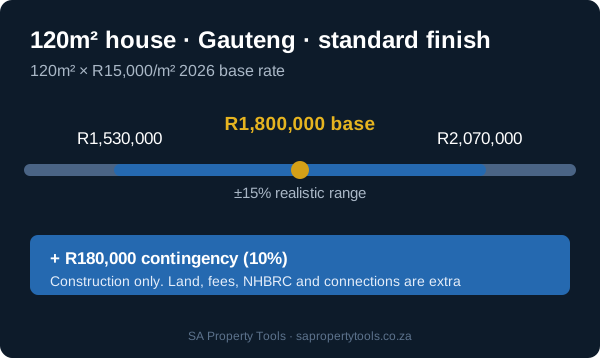
Take a 120m² house in Gauteng, standard finish, new build, the combination this calculator sees most often. Multiply floor area by the 2026 Gauteng provincial average rate: 120 × R15,000 = R1,800,000. New build and standard finish both carry a ×1.00 factor, so neither adjustment moves that number. Your realistic range sits between R1,530,000 and R2,070,000, the ±15% band the calculator applies automatically, and you should still budget a further R180,000 (10%) as contingency on top. Remember this figure is construction only. Land, professional fees, NHBRC enrolment and municipal connections are not in it at all, and can add another 30 to 40% before you have a full project budget, as the section above explains.
Typical Total Cost to Build a House by Size (2026)
If you know your bedroom or unit count but not your floor area yet, this table gives a starting point. These are industry-estimate size ranges, not a fixed rule. Actual floor area varies widely by layout, garage, passages and outdoor rooms, so use the calculator above with your own m² figure once you have house plans. Costs shown use the 2026 Gauteng standard-finish rate (R15,000/m²) for consistency with the worked example above. To convert to your own province, take the floor area figure and multiply it by your province's own rate per m² from the table earlier on this page, instead of Gauteng's R15,000/m².
| House Size | Typical Floor Area | Total Cost (Gauteng, Standard Finish) |
|---|---|---|
| Bachelor / 1-room (granny flat, cottage) | 25–40m² | R375,000–R600,000 |
| 2-bedroom house | 70–100m² | R1,050,000–R1,500,000 |
| 3-bedroom house | 120–150m² | R1,800,000–R2,250,000 |
| 4-bedroom house | 200–250m² | R3,000,000–R3,750,000 |
| Small flat / sectional-title unit | 80–100m² | R1,200,000–R1,500,000 |
These size ranges are industry estimates drawn from South African property-market and cost-guide reporting, not an NHBRC or quantity-surveyor standard. Actual house sizes vary by developer, budget and design. Costs are construction only, at the mid-range provincial rate this calculator uses for Gauteng; apply your own province's rate for other regions, and add professional fees, NHBRC enrolment and municipal connections as covered above.
Get the full picture: costing, staging cash flow and NHBRC rules. Read the Build Cost Planning Guide →
Frequently Asked Questions
Building costs in South Africa range from around R9,100/m² in North West to the Western Cape's R14,800 to R17,000/m² for a standard mid-range finish. KwaZulu-Natal averages R16,700/m² and Gauteng R15,000/m². These are indicative rates for standard residential construction and exclude land, professional fees and municipal connections.
The Western Cape (R14,800 to R17,000/m²) and KwaZulu-Natal (R16,700/m²) are the most expensive provinces to build in, followed by Gauteng (R15,000/m²). The most affordable are North West (R9,100/m²) and Limpopo (R9,600/m²). Run the calculator with your own province and floor area for a figure for your build.
The cost per square metre typically covers labour and materials for the whole building at a standard mid-range finish. It generally excludes: land purchase price, NHBRC enrolment fees, professional fees (up to about 19% of build cost if an architect, land surveyor, structural engineer and quantity surveyor are all appointed, our estimate from ooba's 2026 fee figures), municipal plan approval fees, site preparation and bulk earthworks, municipal connection fees for water, electricity and sewerage, landscaping and movable fixtures like curtains and appliances.
A standard 3-bedroom house in South Africa is typically 120–150m². At mid-range finish rates, this costs approximately R1,090,000–R2,550,000 depending on province, from R9,100/m² (North West) to R17,000/m² (the top of our Western Cape estimate). In Gauteng at R15,000/m², a 130m² home costs roughly R1,950,000 for construction alone, before professional fees, plan approval and connections.
South African quantity surveyors and contractors typically recommend a 10–15% contingency on top of your base construction estimate. Building projects commonly run over budget due to material price changes, scope additions discovered during construction and unforeseen ground conditions. First-time builders should budget 15% contingency; experienced developers typically use 10%.
Renovations typically cost 60–80% of new-build rates per square metre for the affected area, but the total project cost depends heavily on scope. Full gut renovations involving structural changes, new roofing and rewiring can approach new-build costs. Extensions (additions to existing structures) typically cost 10–15% more than standard new-build rates because of tie-in complexity.
It depends on location and market conditions, but building is often cheaper per square metre for larger or customised homes, while buying is usually faster and avoids construction risk. At mid-range finish rates (R9,100–R17,000/m² depending on province), a 130m² new build costs roughly R1,180,000–R2,210,000 for construction alone, before land, professional fees and connections. Comparable existing homes in established suburbs often carry a premium for location and immediate occupancy, but resale prices can also reflect deferred maintenance a new build doesn't have. Compare your own numbers with this calculator rather than relying on a generic rule of thumb.
Johannesburg falls within Gauteng, where mid-range residential construction averages around R15,000 per square metre. A typical 130m² 3-bedroom home therefore costs approximately R1,950,000 for construction alone, before land, professional fees (up to about 19% of build cost, our estimate from ooba's 2026 fee figures), NHBRC enrolment and municipal connection fees. Use the calculator above with Gauteng selected for an estimate matched to your own build size and finish level.
R300,000 is not enough for a standard brick-and-mortar house at mid-range rates (R9,100–R17,000/m²). Even at the lowest province rate this only covers around 33m², too small for a conventional home. R300,000 can realistically fund a small basic structure, a serviced site's connections, or act as a deposit or contingency contribution alongside a bond for a larger build. Alternative construction methods (prefab or IBR-clad steel frame) can stretch further per Rand than conventional brick construction, but R300,000 alone won't complete a full conventional family home in most of South Africa.
This building calculator South Africa's homeowners and developers use draws on real 2026 provincial cost-per-m² data from ooba (which credits luxliveproperty), with our own estimate for the Western Cape, not a single national average, so an estimate for a Gauteng build reflects Gauteng rates, not a blended figure that under- or over-states your actual province.