Rental Yield Calculator South Africa
Calculate your gross and net rental yield including all holding costs. Compare against SA benchmarks.
Quick answer: Rental yield is calculated as annual rental income divided by property price, expressed as a percentage. Gross yield ignores costs; net yield deducts rates, levies, insurance, maintenance and management fees. The South African national average gross yield is approximately 11.53% (Global Property Guide, Q2 2026), varying significantly by city.
Rental Yield Calculator
Enter your property details below to calculate gross and net yield
Cost Breakdown
| Item | Monthly | Annual |
|---|
* Estimates only. Bond repayments, income tax on rental income, and capital growth are not included. Consult a financial advisor for full investment analysis.
Weighing Up More Than One Property?
Put up to 3 properties side by side and see gross yield, net yield and monthly profit compared in one view.
Compare Properties →Ready to Finance Your Investment Property?
Bond originators submit to multiple banks simultaneously and often secure better rates than going direct, at no cost to you.
Apply via BetterBond (free) →Affiliate disclosure: we may receive a referral fee if you apply through these links, at no cost to you.
How to Use This Calculator
- Purchase PriceEnter the total purchase price of the property in Rand.
- Monthly Rental IncomeEnter the gross monthly rent you expect to receive or currently receive.
- Vacancy Rate (%)Enter your expected vacancy rate. Typical SA vacancy is 5 to 8%.
- Managing Agent Fee (%)Enter your agent's management fee. Typical SA agents charge about 10% plus VAT.
- Monthly Rates & TaxesEnter the property's monthly municipal rates and taxes.
- Monthly Levies (Sectional Title)Enter the monthly body corporate levy, or leave it at zero for freehold.
- Monthly Maintenance BudgetEnter your ongoing monthly maintenance provision.
- Monthly InsuranceEnter the monthly building and landlord insurance premium.
- Click Calculate Rental YieldReview your gross yield before costs, net yield after all costs, monthly and annual profit, and a colour-coded verdict against SA benchmarks.
What is Rental Yield?
Rental yield is the annual return you earn on an investment property expressed as a percentage of the property's purchase price. There are two types: gross yield (before costs) and net yield (after all holding costs). Gross yield is the quick headline number; net yield is the one that actually tells you whether the property makes financial sense after you pay all the bills.
Gross Yield = (Annual Rental Income ÷ Purchase Price) × 100
Net Yield = (Annual Net Income ÷ Purchase Price) × 100
The gap between gross and net yield is often larger than investors expect. A property returning 8% gross can easily fall to 5% net once you account for vacancy periods, agent management fees (about 10% of rent plus VAT, PayProp 2026), municipal rates, levies, building insurance, and maintenance. This is why running the full net yield calculation before committing to a purchase is essential, not optional.
Rental yield is also the primary metric bond originators and banks use to assess whether an investment property is commercially viable. Lenders typically want to see that the monthly rental covers at least 80–100% of the monthly bond repayment before they will consider investment property income in your affordability assessment.
What Is a Good Rental Yield in South Africa?
As a benchmark: below 6% gross is considered weak, 6–8% is acceptable, and above 8% gross is strong for South African residential property. Net yield of 4–6% after all costs is typical for well-located residential buy-to-let investments.
Yields vary significantly by city, property type and suburb. In Cape Town's high-demand Atlantic Seaboard, gross yields often sit between 4–6% because capital values have risen faster than rentals. Investors there are betting on appreciation rather than income. In Durban and Pretoria, residential yields of 7–9% gross are more achievable, particularly in sectional title complexes near universities or business nodes. Johannesburg's market is broad: central nodes like Sandton produce lower yields while outlying areas can return 9–11% gross on the right buy. For short-term rental strategies, Airbnb and holiday let properties in tourist areas can achieve significantly higher yields. Use the Holiday Let & Airbnb Yield Calculator to model nightly rate occupancy and platform fees separately.
Common Mistakes SA Investors Make When Calculating Yield
The most common error is using the asking price rather than the actual purchase price plus all acquisition costs. Transfer duty, conveyancing fees and bond registration costs add 8–12% to your effective entry cost on most purchases, and that directly reduces your real yield. A second mistake is ignoring vacancy: most buy-to-let properties sit empty for 3–6 weeks per tenant turnover. Always apply a realistic vacancy rate: 8% is a conservative starting point.
Rental Yield at Current SA Interest Rates
At the current prime rate of 10.75%, most investment bonds are priced at prime plus 0.5 to 1.5% (our estimate), putting your effective borrowing rate at 11.25–12.25%. For a property to be cash-positive from day one (meaning rental income covers the full bond repayment and all running costs), you typically need a gross yield above 10% at current rates. Most SA residential property does not clear this threshold, which is why many buy-to-let investors accept a monthly shortfall in exchange for capital growth over time. The SARB rate cycle matters here: every 25bp cut reduces the bond repayment on a R1.5 million loan by approximately R250 per month, meaningfully shifting a borderline property into positive cash flow territory. Use this calculator to model your break-even rental at different interest rate scenarios before committing to a purchase.
Where the Gross-to-Net Gap Goes
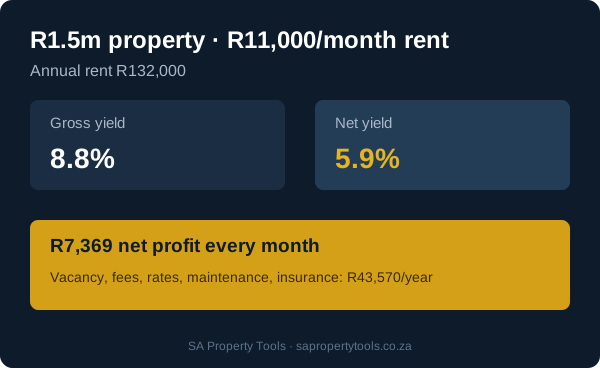
The 3–4 percentage point gap between gross and net yield is not abstract: it has a specific breakdown. On a typical SA residential rental, the main deductions as a percentage of gross rent are: vacancy at 8% of annual rent (approximately four weeks empty per tenant turnover, costing around 0.65% of yield); managing agent fees at about 10% of collected rent plus VAT (0.8–0.9% of yield); municipal rates at 0.4–0.8% of property value annually (0.4–0.7% of yield); a maintenance budget of 0.5–1% of property value annually (0.5–0.9% of yield); and building insurance at approximately 0.15% of property value (for freehold; a sectional title property substitutes a body corporate levy, which typically runs higher than standalone insurance since it also covers common-area costs). On an R1.5 million freehold property renting at R11,000 per month (8.8% gross), these deductions typically reduce net yield to around 5.5–6% (see the full worked example below for the exact breakdown). The maintenance figure is the one most first-time investors underestimate: older properties, particularly sectional title units with deferred body corporate maintenance, can require R15,000–R30,000 in reactive repairs in a single year.
Yield vs Capital Growth: The SA Investor Trade-off
High rental yield and strong capital growth rarely occur in the same property simultaneously. Areas delivering 9–11% gross yields (typically smaller cities, outlying nodes, or purpose-built student accommodation) often appreciate more slowly than prime nodes like Cape Town's Atlantic Seaboard or Sandton. The Atlantic Seaboard produces gross yields of 4–5% but has delivered capital growth of 7–9% annually over the past decade; the income return is low but the total return is competitive. Before targeting yield alone, define your investment horizon: if you plan to hold for 15 or more years and can absorb a monthly shortfall, a lower-yield high-growth property may deliver a superior total return at exit. Shorter hold periods with tighter cash flow requirements favour higher-yield nodes where the income carries more of the return from year one.
A Worked Example
Take the R1.5 million freehold property renting at R11,000 a month from earlier, worked through in full. Annual rent comes to R132,000, an 8.8% gross yield. Apply an 8% vacancy rate and you lose R10,560 in a normal year of tenant turnover. A 10% managing agent fee on the rent you actually collect adds R12,144 (before VAT). Municipal rates, maintenance and insurance at typical monthly figures (R900, R750 and R190) add a further R22,080 for the year. Total costs come to R44,784, leaving R87,216 in net income, an R7,268 monthly profit and a net yield of 5.8%. That gap between the 8.8% an agent quotes you and the 5.8% that actually lands in your account is the whole reason net yield matters more than gross.
Frequently Asked Questions
South Africa’s national average gross rental yield is approximately 11.53%, according to Global Property Guide Q2 2026 data. Johannesburg achieves around 13.47% gross yield, driven by lower purchase prices relative to rental income. Cape Town apartments average around 9.49% gross, held down by higher property values. These are national averages. Individual properties vary significantly based on location, property type and management quality.
No. A 4% gross yield is below the SA benchmark and is unlikely to be viable for buy-to-let investors at current interest rates. On a R2 million property, 4% gross yields R80,000 per year. After vacancy, rates, levies, maintenance and a management fee, net yield typically falls below 2%, well short of covering bond repayments at prime plus 0.5% (currently 11.25%). Most SA investors require a minimum of 8% gross to achieve positive cash flow.
Yes, 8% gross yield is a solid benchmark for South African buy-to-let. At this level rental income should cover a significant portion of bond repayments and running costs. Whether it leaves positive cash flow depends on your bond terms and deposit size. The national gross average is approximately 11.53%, so 8% is slightly below average but acceptable in well-located urban nodes where capital appreciation compensates.
A 5% gross yield means annual rental income equals 5% of the purchase price. On a R1.5 million property that is R75,000 per year or R6,250 per month in gross rent. After deducting vacancy, costs and management fees, net yield typically falls to 3–3.5%, which at current SA interest rates (prime 10.75%) is unlikely to cover bond repayments. A 5% gross yield is generally considered weak for pure investment purposes in the current rate environment.
A 6% gross yield means annual rent equals 6% of the property value. On a R1.5 million property that is R90,000 per year (R7,500/month). Net yield after all costs typically lands at 4–4.5%. This is borderline viable in SA at current rates. In high-value markets like Cape Town’s Atlantic Seaboard or Sandton, 6% is often the ceiling and is more acceptable where strong capital appreciation is expected to supplement the income return.
High-yield properties (above 12% gross) in SA typically carry elevated risk: higher vacancy rates, lower-income tenant profiles with greater arrears risk, deferred maintenance that erodes returns over time, and weaker long-term capital appreciation. A property showing 14% gross yield with 20% vacancy and high maintenance costs can deliver lower net returns than a well-located 8% gross property. Always model net yield with realistic vacancy and cost assumptions before comparing headline yields.
The 1% rule is a US investment shortcut where monthly rent should equal at least 1% of the purchase price, so a R1 million property would need R10,000/month rent, equivalent to a 12% gross yield. This rule was developed for the US market and does not translate directly to South Africa. The SA equivalent benchmark is 8–10% gross yield, factoring in the local bond structure, prime lending rate and property cost base. Use SA-specific yield benchmarks rather than the US 1% rule.
Rental yield measures income only: annual rent as a percentage of property value. Return on investment (ROI) is broader: it includes rental income plus capital appreciation relative to your total invested capital, including the deposit, transfer costs and any improvements. A property with 7% gross yield and 5% annual capital growth delivers a combined ROI of approximately 12%, significantly stronger than yield alone suggests. Use the Property ROI Calculator for a complete investment picture.
A gross yield above 8% is considered strong for SA residential property. 6–8% gross is acceptable. Below 6% gross is weak and may not cover bond repayments and costs. Net yields of 4–6% after all costs are typical for well-located buy-to-let properties.
Gross rental yield is annual rent divided by property value. It ignores all expenses. Net rental yield deducts vacancy losses, levies, rates, insurance, maintenance and management fees before dividing by property value. Net yield gives you the realistic return on your investment.
Gross yield = (monthly rent × 12) ÷ purchase price × 100. For net yield, subtract annual costs (vacancy losses, agent fees of about 10% of rent plus VAT, rates, levies, maintenance, insurance) from annual rent, then divide by the purchase price and multiply by 100. A R1,000,000 flat renting at R9,000 a month is 10.8% gross.
Use 8% (about one month a year) as a cautious baseline for most SA metros, and less in strong areas such as Cape Town: TPN's Q3 2024 survey put the Western Cape at only 1.07%, against 5.81% in Gauteng, 7.12% in KwaZulu-Natal and 5.07% nationally. In secondary cities or student areas with seasonal demand, budget 10 to 12% (our estimate).
Include: vacancy allowance, managing agent fee (about 10% of rent plus VAT, PayProp 2026), monthly rates and taxes, maintenance budget (typically 0.5–1% of property value per year), and either a body corporate levy (sectional title, which usually already covers building insurance) or standalone building insurance (freehold). Don't include both a levy and separate building insurance unless your scheme genuinely charges both. Bond interest is a financing cost, not included in yield but critical for cash flow analysis.
Yes. Net rental income (rent minus allowable deductions) is added to your taxable income and taxed at your marginal SARS rate. Allowable deductions include bond interest, rates, levies, insurance, maintenance and management fees, but not the capital portion of bond repayments.
You don't need a separate spreadsheet for a single property. This rental property calculator already runs the full gross and net yield workflow most SA investor spreadsheets are built to do (rent, vacancy, agent fee, rates, levies, maintenance and insurance), with an instant colour-coded verdict. A spreadsheet is only worth building separately if you want to track a portfolio of multiple properties side by side or model custom cost categories beyond what's listed here.