FLISP Calculator: First Home Finance South Africa
Find your government housing subsidy in seconds. Enter your income to see exactly how much FLISP / First Home Finance reduces your bond.
Quick answer: FLISP (First Home Finance) is a South African government subsidy for first-time buyers in the gap market, administered via participating banks. Households earning R3,501–R22,000 per month can qualify for a subsidy of roughly R38,911 to R169,265, applied directly to reduce the required bond amount (NHFC, 2026).
FLISP / First Home Finance Calculator
Income range: R3,501 – R22,000/month · Subsidy: R38,911 – R169,265
🏦 Apply for Your Bond and FLISP Subsidy
You need a formal bond approval letter from an SA bank before applying to the NHFC for your FLISP subsidy. A bond originator submits your application to multiple banks simultaneously at no cost, and can assist with the FLISP application process.
Once your bond is approved, apply directly to the NHFC at nhfc.co.za with your bond approval letter, offer to purchase, ID, and 3 months' payslips.
Affiliate disclosure: we may receive a referral fee if you apply through these links, at no cost to you.
📋 NHFC Subsidy Reference Table: Selected Income Brackets
The subsidy decreases linearly as income rises. The table below shows approximate subsidy amounts at key income levels.
| Gross Monthly Income | Subsidy Amount | Subsidy Classification |
|---|---|---|
| R 3,501 – R 3,700 | R 169,265 | Maximum subsidy |
| R 5,000 | ≈ R 158,700 | High subsidy |
| R 7,500 | ≈ R 141,100 | High subsidy |
| R 10,000 | ≈ R 123,500 | Moderate subsidy |
| R 12,500 | ≈ R 105,900 | Moderate subsidy |
| R 15,000 | ≈ R 88,200 | Standard subsidy |
| R 17,500 | ≈ R 70,600 | Lower subsidy |
| R 20,000 | ≈ R 53,000 | Minimum band |
| R 21,801 – R 22,000 | R 38,911 | Minimum subsidy |
Source: NHFC First Home Finance programme. Intermediate values calculated using the NHFC linear sliding scale. Verify exact amounts at nhfc.co.za before applying.
How to Use This Calculator
- South African Citizen or Permanent Resident?Leave this toggle on if you are a South African citizen or permanent resident. FLISP / First Home Finance is not available otherwise, regardless of income.
- Gross Monthly IncomeEnter your total monthly income before tax and deductions. For joint applications, enter the combined household gross income. The qualifying range is R3,501 to R22,000 per month.
- Application TypeSelect individual or joint application, since married or cohabiting couples applying together use combined household income.
- Property Purchase PriceEnter the full purchase price of the property you are buying, used to calculate your bond amount after the subsidy is applied.
- Cash DepositEnter any deposit you are contributing. The FLISP subsidy effectively acts as an additional deposit, so many buyers use R0 here.
- Interest Rate (%)Enter the interest rate your bank offers, defaulting to prime at 10.75%.
- Bond Term (years)Select your bond term, defaulting to 20 years, to see your actual monthly repayment.
- Click Calculate My FLISP SubsidyResults show your exact subsidy on the NHFC sliding scale, your reduced bond amount, and your new monthly repayment compared to without the subsidy.
Know your subsidy, now confirm your affordability. Use the Bond Affordability Calculator to see exactly how much SA banks will lend you alongside your FLISP subsidy.
Bond Affordability Calculator →What Is FLISP, and Why Was It Renamed First Home Finance?
The Finance Linked Individual Subsidy Programme (FLISP) was a government initiative introduced to help South Africans in the "gap market": people who earn too much to qualify for an RDP house but too little to comfortably afford a bond on the open market. The programme was administered by the NHFC (National Housing Finance Corporation) and provided a once-off subsidy that reduced the required bond.
The government subsequently rebranded FLISP as First Home Finance (FHF). The name changed; the programme did not. Same income brackets, same subsidy amounts, same NHFC administration, same eligibility criteria. Because the rename hasn't fully caught on, you will encounter both "FLISP" and "First Home Finance" in government documentation, bank materials and property industry communication. They are the same thing.
How the FLISP Subsidy Is Calculated
The subsidy is calculated on a linear sliding scale set by the NHFC. The scale runs from a maximum subsidy of R169,265 (for earners at the bottom of the qualifying band, R3,501/month gross) to a minimum of R38,911 (for earners at the top of the band, R22,000/month gross). Every rand of additional income reduces the subsidy by approximately R7.05.
The formula: Subsidy = R169,265 − [(Income − R3,501) ÷ R18,499] × R130,354
This means the subsidy decreases smoothly with income. There are no "cliff edges" where a small income increase dramatically drops your subsidy. A household earning R12,000/month gross receives approximately R109,000 in subsidy. At R15,000/month, it drops to approximately R88,000. The subsidy is substantial at all qualifying income levels.
The Gap Market Problem FLISP Solves
South Africa has a well-documented housing "gap market": households earning between approximately R3,500 and R25,000 per month. These households earn too much to qualify for government RDP housing (which targets incomes below R3,500/month), but not enough to access formal bank bond finance without significant strain. Property prices in most SA metros have moved beyond what this income range can comfortably afford at market interest rates.
FLISP directly addresses this by injecting a capital subsidy at the point of purchase. A subsidy of R100,000 on a R450,000 property reduces the required bond from R450,000 to R350,000, dropping the monthly repayment at prime rate (10.75%) over 20 years from approximately R4,569 to approximately R3,553. That R1,015 monthly saving is the difference between qualifying and not qualifying for many households in the gap market.
Step-by-Step: How to Apply for FLISP in South Africa
Step 1: Get a formal bond pre-approval. Apply to an SA bank (or use a bond originator like BetterBond to apply to multiple banks simultaneously). You need a formal approval letter, not just an estimate. Without this, the NHFC cannot process your FLISP application.
Step 2: Sign an offer to purchase. Identify your property and sign an offer to purchase. The OTP must be subject to bond approval and FLISP subsidy approval.
Step 3: Submit to NHFC. Go to nhfc.co.za and submit your FLISP / First Home Finance application with: your ID, 3 months' recent payslips, the formal bond approval letter and the signed offer to purchase.
Step 4: NHFC assessment and payment. The NHFC assesses your application and, if approved, pays the subsidy directly to the bank at bond registration. The subsidy reduces your loan balance on day one. You never see the money in your account; it is applied directly to the bond.
Step 5: Register. The conveyancing attorney registers the reduced bond. Your title deed is registered in your name. Your monthly repayment is calculated on the reduced bond amount. If you are near the R22,000 gross income ceiling, use PayTools to verify your exact gross household income before applying, since a single payslip discrepancy can disqualify an otherwise valid FLISP application. The FLISP subsidy is administered by the National Housing Finance Corporation (NHFC) and is funded from the national housing budget, and allocations are subject to annual budget availability. Applications are processed through an accredited bank or originator, not directly through government. If your application is approved in principle but funding is exhausted for the financial year, your approval may be deferred to the next allocation cycle, so applying early in the financial year (April–June) improves your chances of receiving the subsidy in the same transfer year.
A Worked Example
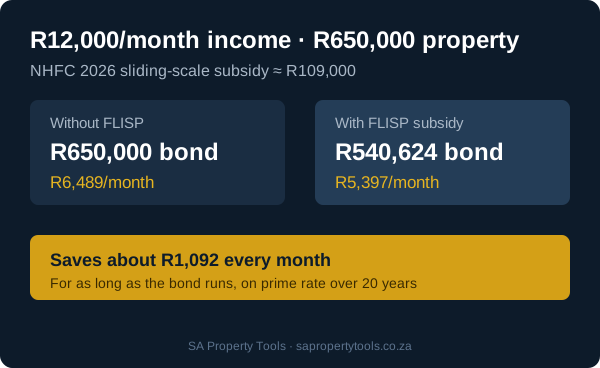
A household earning R12,000 a month gross qualifies for a subsidy of roughly R109,000 on the NHFC's 2026 sliding scale. Say they are buying a R650,000 property. Without FLISP, a full R650,000 bond at prime (10.75%) over 20 years costs R6,599 a month. With the subsidy applied straight to the bond, the loan drops to R540,624 and the repayment falls to R5,489, a saving of about R1,110 every month for as long as the bond runs. That is the real effect of FLISP. Not money in your pocket on day one, but a permanently smaller repayment because the bond itself is smaller.
Want the full picture before you apply? Read the complete FLISP Subsidy Guide & Checklist →
Frequently Asked Questions
FLISP (Finance Linked Individual Subsidy Programme), now officially renamed First Home Finance, is a South African government housing subsidy administered by the NHFC. It provides a once-off cash subsidy of R38,911 to R169,265 to qualifying first-time home buyers. The subsidy is paid directly to the bank to reduce your outstanding bond. It does not go to you in cash. The amount depends on your gross monthly income on a sliding scale: the lower your income, the higher your subsidy.
To qualify for FLISP / First Home Finance in South Africa you must: (1) be a South African citizen or permanent resident; (2) earn a gross monthly income between R3,501 and R22,000 (for joint applicants, combined household income applies); (3) be a first-time home buyer who has never owned property or received a government housing subsidy before; (4) have an approved home loan from a participating bank; (5) be buying the property for your own residential occupation, not as an investment or rental property.
The FLISP / First Home Finance subsidy ranges from R38,911 (for earners at R22,000/month) to R169,265 (for earners at R3,501/month). The subsidy is calculated on a linear sliding scale. Every additional rand of monthly income reduces the subsidy by approximately R7.05. These figures are current as of May 2026; check the NHFC website for the latest published subsidy table.
Yes. The government officially renamed the Finance Linked Individual Subsidy Programme (FLISP) to First Home Finance (FHF) in recent years. The programme operates identically: same income brackets, same subsidy amounts, same NHFC administration, same eligibility criteria. Many banks, agents and applicants still use the FLISP name. Both names refer to the same subsidy.
No. FLISP / First Home Finance requires a new approved home loan. You must have received a formal bond approval letter from a participating SA bank before you can apply. The subsidy is applied at bond registration to reduce the loan amount. It cannot be applied retrospectively to an existing registered bond. The approved loan and property purchase must be specifically for the qualifying property.
The FLISP application process: (1) get a formal bond approval letter from an SA bank (BetterBond can submit to multiple banks simultaneously); (2) sign an offer to purchase on a qualifying property; (3) submit your FLISP application to the NHFC at www.nhfc.co.za with your bond approval letter, ID, proof of income and offer to purchase; (4) the NHFC processes your application and, if approved, pays the subsidy directly to the bank at bond registration. A bond originator can assist with the FLISP application alongside the bond application.
FLISP / First Home Finance does not have a strict property price ceiling, but the subsidy is designed for affordable housing. The property must be formally titled (registered), habitable and comply with National Building Regulations. Most FLISP purchases fall in the R300,000–R600,000 range, though buyers use the subsidy for higher-value properties by contributing a larger bond. The property must be for owner-occupation only.
FLISP (First Home Finance) subsidies range from R38,911 to R169,265 depending on your income. Earners between R3,501 and R22,000 per month qualify. The lower your income within that band, the higher your subsidy. The subsidy is paid directly to reduce your bond amount.
The FLISP subsidy is paid directly to the bank and applied to reduce your outstanding home loan balance. If you qualify for a R100,000 subsidy on a R500,000 property, your bond is effectively reduced to R400,000, lowering your monthly repayment accordingly.
Yes. FLISP (now branded First Home Finance) is still active in 2026 and administered by the NHFC. You apply through your bank or a registered originator once your home loan is approved. The subsidy is not a grant to spend. It goes directly to reduce your bond.
For first-time home buyers, the government housing subsidy people usually mean is FLISP / First Home Finance, worth R38,911 to R169,265 depending on your gross monthly income (NHFC quantum table). It's a once-off amount paid directly to your bank to reduce your bond, not a monthly payment or a cash grant, and it only applies to households earning R3,501 to R22,000 per month.
Yes. FLISP / First Home Finance is a national subsidy administered centrally by the NHFC, not a province-by-province programme. The same income bands and subsidy amounts apply no matter which South African province you're buying in. Some provincial Department of Human Settlements pages still publish outdated FLISP-era rules from before the February 2022 revision, so confirm directly with the NHFC if a provincial source contradicts the current criteria.
FLISP was created by the national Department of Human Settlements for South Africa's "gap market": households earning too much to qualify for a free RDP house but too little to comfortably afford a bond on their own. The National Housing Finance Corporation (NHFC) administers it nationally, and the programme was substantially revised and rebranded First Home Finance in February 2022 under the National Housing Code.
Certified copies of: your Smart Card or bar-coded ID (or permanent residence permit), IDs or birth certificates of financial dependants, your marriage certificate or customary-union affidavit where applicable, proof of income, 3 months of bank statements, your home loan Approval in Principle, and the signed offer to purchase (NHFC Annexure A). See the full FLISP Subsidy Guide & Checklist for the complete document-by-document breakdown.
Log into the First Home Finance applicant portal at fhf.nhfc.co.za with the username you registered. It shows your application's progress directly. This is a separate system from the general Housing Subsidy System (HSS) used for RDP housing waiting lists, so don't confuse the two. If a bank or bond originator submitted your application on your behalf, they can also check progress for you. For anything the portal doesn't clarify, contact the NHFC directly at firsthomefinanceenquiries@nhfc.co.za.