The Complete FLISP Subsidy Guide & Checklist 2026: Criteria, Documents and Payouts
Quick answer: FLISP — now First Home Finance — pays first-time buyers earning R3,501–R22,000 per month a once-off subsidy of R38,911.00 to R169,264.60 on a 91-step income sliding scale (NHFC quantum table, effective 1 April 2023). Applications run through the NHFC portal, and the current criteria contain no marital status or dependant requirement.
FLISP is South Africa's most under-used housing benefit: a once-off government subsidy of up to R169,265 for first-time buyers in the R3,501–R22,000 income bracket, paid straight into your home purchase — yet most qualifying buyers have never heard of it, and much of the advice published about it is out of date. This guide consolidates the current NHFC rules into one reference: the real qualifying criteria, the exact subsidy amounts by income, the complete application and disbursement document checklists drawn from the NHFC's own annexures, and the step-by-step application route. Start by checking your own number on the FLISP Subsidy Calculator.
In this guide
What Is FLISP / First Home Finance?
First Home Finance — still widely known by its old name FLISP (Finance-Linked Individual Subsidy Programme) — is a once-off housing subsidy created by the Department of Human Settlements for the "gap market": households earning too much for a free government house but too little to comfortably afford a bond. The National Housing Finance Corporation (NHFC) administers it nationally. The programme was substantially revised in February 2022 under the National Housing Code, which rebranded it and widened it beyond mortgage-only finance.
The subsidy can be used to reduce your home loan amount, cover the shortfall between your approved loan and the purchase price, serve as a deposit, or pay buying costs such as conveyancing fees. Qualifying applicants can buy an existing or new home, buy a vacant serviced stand linked to an NHBRC-registered homebuilder contract, or build on a serviced stand they already own through an NHBRC-registered builder. Beyond mortgages, First Home Finance now works with unsecured housing loans from NCR-registered lenders, pension- or provident-backed loans, community savings schemes such as stokvels and co-operatives, employer housing schemes including GEHS, instalment sale and rent-to-own agreements, Permission-to-Occupy arrangements in rural areas, and even a household's own savings (NHFC, 2026).
The Current Qualifying Criteria (2026)
The NHFC's published criteria contain six requirements — and, importantly, no marital status or dependant condition. To qualify, you must meet all of the following (NHFC, 2026):
Official qualifying criteria
- South African citizen with a valid ID, or permanent resident with a valid permit
- Over 18 years old and competent to legally contract
- Never benefited from a Government Housing Programme from any sphere, arm or entity of government
- Never owned a home — checked against the Deeds Register
- An Approval in Principle for a home loan from an NCR-registered bank or non-bank lender, or another Policy-approved financing route
- Total gross household income between R3,501 and R22,000 per month
Older FLISP-era guidance, still repeated on some provincial Department of Human Settlements pages and bank sites, required single applicants to have a financial dependant. That rule predates the February 2022 policy revision and does not appear in the current NHFC criteria or the National Housing Code; the official application form itself lists "Single without dependants" as a valid marital status category. If an advisor cites the old rule, confirm directly with the NHFC at firsthomefinanceenquiries@nhfc.co.za. Note that income is assessed at household level: for married and cohabiting couples the combined gross income must fall inside the R3,501–R22,000 band, and a spouse's previous property ownership or subsidy counts against the household.
Earning inside the bracket? Your exact subsidy amount takes ten seconds to check.
Calculate My Subsidy →How Much You Get: The Subsidy Quantum Table
The subsidy runs on a 91-step sliding scale published by the NHFC (implementation date 1 April 2023): the less you earn, the more you receive. The official limits are R169,264.60 at the bottom of the income band and R38,911.00 at the top. The extract below shows the shape of the scale — every band moves in roughly R200 income increments, each worth about R1,449 of subsidy:
| Step | Gross monthly household income | Subsidy amount |
|---|---|---|
| 1 | R3,501 – R3,700.99 | R169,264.60 |
| 10 | R5,301 – R5,500.99 | R156,225.97 |
| 20 | R7,301 – R7,500.99 | R141,738.61 |
| 30 | R9,301 – R9,500.99 | R127,251.25 |
| 40 | R11,301 – R11,500.99 | R112,763.89 |
| 50 | R13,301 – R13,500.99 | R98,276.53 |
| 60 | R15,201 – R15,400.99 | R83,789.17 |
| 70 | R17,201 – R17,400.99 | R69,301.81 |
| 80 | R19,601 – R19,800.99 | R54,814.45 |
| 91 | R21,801 – R22,000.99 | R38,911.40 |
Source: NHFC Subsidy Quantum Table, effective 1 April 2023. The subsidy is paid once only, never directly to you: it goes to your lender, the transferring attorney's trust account, or (for self-builds) the NHBRC-registered contractor in milestone payments. No lender, agent or originator may charge any fee for a First Home Finance application — a fee request is a scam and should be reported to the NHFC.
Application Documents Checklist (Annexure A)
The NHFC's official application-stage checklist requires certified copies of the following. Gather everything before you start the portal application — missing documents are the single biggest cause of stalled applications:
Application stage: all applicants
- Smart Card or bar-coded ID for every adult member of the household (permanent residents: bar-coded permanent residence permit)
- Birth certificate or ID of each financial dependant — dependants are not limited to biological children and can include a parent or other family member you support
- Marriage certificate (civil unions included), or affidavit for a customary-law union; divorce settlement or spouse's death certificate where applicable
- Proof of income: latest payslip if employed; 6 months of bank statements plus an accountant's letter if self-employed; 12 months of payslips if you earn commission only
- 3 months of bank statements reflecting the payslip income, to verify what you declared (employed applicants)
- Home loan Approval in Principle or grant letter — or proof of own resources, or a stokvel/community savings resolution, depending on your financing route
- Signed agreement of sale for the property — or, in rural PTO cases, the seller's and buyer's Permission to Occupy plus a Traditional Authority letter approving the sale
- For a self-build: title deed, municipal stand-allocation letter, or Permission to Occupy for the land
Disbursement Documents & Self-Build Rules (Annexure B)
Approval is not payout. Before the NHFC disburses a single rand, a second checklist applies — and for self-builds it is strict. For ordinary mortgage-backed purchases, the attorneys confirm lodgement or registration and provide pro-forma invoices, and the subsidy pays out around registration. For building on your own stand, the NHFC's disbursement checklist requires (NHFC Annexure B):
Self-build disbursement requirements
- A building plan approved by the municipality — or by the Traditional Council in rural areas where municipalities do not approve plans
- Proof of the builder's NHBRC registration and a house enrolment certificate — no disbursement is made for a house not enrolled with the NHBRC, or to a builder not registered with it
- A detailed building contract between you and the builder with defined payment milestones
- Building material quotations and the builder's bank confirmation letter, both not older than 3 months
- Your signed consent authorising the NHFC to pay each milestone — accompanied by photographs proving the previous milestone was completed
- Signed delivery notes confirming building materials were delivered for each stage
The milestone-and-photograph mechanism means a self-build subsidy is released in stages against physical progress, never as a lump sum — plan your builder's cash flow around it. Buying an existing home is administratively far simpler: the subsidy routes through the conveyancing process alongside your bond, which is covered step by step in our FLISP payout timeline guide.
How to Apply Step by Step
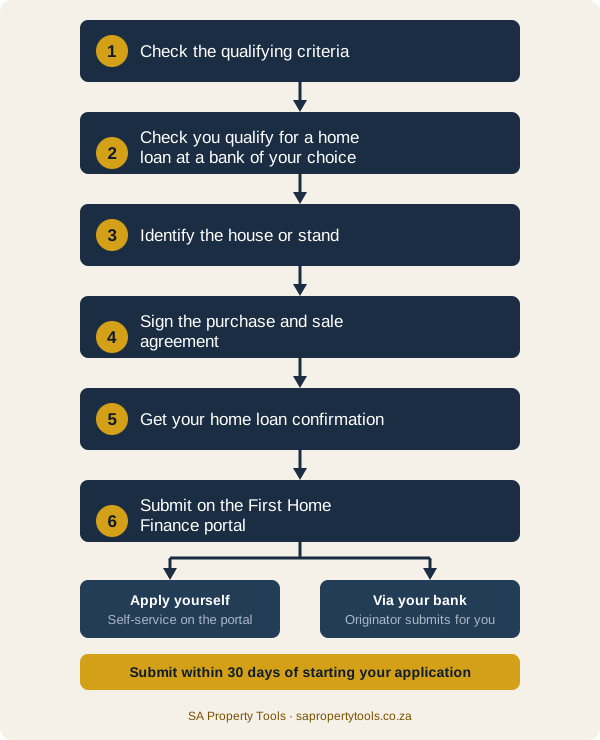
The NHFC's official route has six steps: check the qualifying criteria, check that you qualify for a home loan at a bank of your choice, identify the house or stand, conclude a purchase and sale agreement, obtain the home loan confirmation, and then complete and submit the application on the First Home Finance portal on the NHFC website. The portal offers two registration types: "I am intending to apply for myself" for individual self-service applicants, and "I will be applying on behalf of others" for vetted organisations such as banks and bond originators — so you can apply yourself or let your bank's originator submit for you. A saved application must be submitted within 30 days, and the portal lists any missing documents against your profile.
Enquiries go to firsthomefinanceenquiries@nhfc.co.za and complaints to firsthomefinancecomplaints@nhfc.co.za. The full portal walkthrough, screen by screen, is in our FLISP requirements and application form guide.
Know your number before you talk to the bank — the subsidy changes what you can afford.
Run the FLISP Calculator →Free Download
FLISP Subsidy Guide & Checklist 2026 (PDF)
Keep the full guide on hand: print it, save it or share it with your family.
Download PDF GuideFrequently Asked Questions
The First Home Finance subsidy ranges from R38,911.00 to R169,264.60 on a 91-step sliding scale linked to gross monthly household income (NHFC quantum table, effective 1 April 2023). The lowest earners in the band — R3,501–R3,700.99 per month — receive the maximum R169,264.60, and the amount steps down roughly R1,449 for every R200 of additional income, reaching R38,911.40 at the top band of R21,801–R22,000.99 per month.
Yes. The current NHFC qualifying criteria contain no marital status or dependant requirement — eligibility rests on citizenship or permanent residency, being over 18, first-time buyer status, no prior government housing subsidy, an Approval in Principle for a home loan, and gross household income of R3,501–R22,000 per month (NHFC, 2026). Some provincial pages still repeat the older FLISP-era dependant rule, which predates the February 2022 National Housing Code revision — confirm with the NHFC directly if it is cited.
Certified copies of: your Smart Card or bar-coded ID (or permanent residence permit), IDs or birth certificates of financial dependants, your marriage certificate or customary-union affidavit where applicable, proof of income (a payslip if employed, 6 months of bank statements if self-employed, or 12 months of payslips if commission-only), 3 months of bank statements verifying declared income, your home loan Approval in Principle or proof of another accepted financing route, and the signed agreement of sale (NHFC Annexure A).
Yes — with strict conditions. The stand must be serviced and owned by you (or held under a Permission to Occupy in rural areas), the builder must be NHBRC-registered, the house must be enrolled with the NHBRC before any disbursement, and the building plan must be approved by the municipality or Traditional Council. The subsidy is then paid to the builder in milestone payments, each released only after you sign consent supported by photographs of the completed previous milestone (NHFC Annexure B).
Apply online through the First Home Finance Application Portal on the NHFC website. Register under “I am intending to apply for myself” as an individual, or let your bank or bond originator submit on your behalf through the agent registration route. You need a home loan Approval in Principle or another accepted financing route before applying, and a saved portal application must be submitted within 30 days. Enquiries: firsthomefinanceenquiries@nhfc.co.za.