Plaster Calculator, South Africa
Calculate cement bags and plaster sand for any SA wall. Covers scratch and finish coats at the Concrete Society's 1:6 and 1:4.5 mixes.
Quick answer: A two-coat plaster system (12mm scratch coat plus 6mm finish coat) is 18mm thick. Before wastage, an internal wall at a 1:6 mix takes about 6kg of cement and 24 litres of plaster sand per m², and an external wall at 1:4.5 about 7.5kg and 22.5 litres (our calculation from the Concrete Society of Southern Africa's 2024 yield table).
Plaster Calculator
Two-coat plaster: 12mm scratch coat plus 6mm finish coat
For planning purposes only. Allow new plaster a minimum of 28 days before painting.
How to Use This Calculator
- Enter wall lengthEnter the total length of the wall to be plastered, in metres.
- Enter wall heightEnter the wall height in metres, floor to ceiling.
- Enter openings deductionEnter the total area of doors and windows to subtract from the wall, in square metres.
- Select plaster systemChoose the two-coat system for scratch plus finish, or scratch only or finish only if you're calculating for a specific stage of the job.
- Select wall locationChoose internal, external or wet area. Internal walls use the Concrete Society's 1:6 mix (200 litres of sand per 50kg bag); external and wet-area walls use the richer 1:4.5 mix (150 litres per bag), for every coat.
- Select wastage factorChoose 10% for a standard layout, 15% for uneven masonry or many reveals, or 20% for rough backgrounds (the allowance the Concrete Society's own example uses).
- Click Calculate Plaster MaterialsResults show total cement bags, the cement for each coat, and plaster sand in cubic metres and bulk bags, all including wastage.
Plastering in South Africa: The Complete Guide
Plastering is the process of applying a cement-sand mortar to masonry walls to create a smooth, even surface ready for painting or tiling. In South Africa, the usual approach is a two-coat plaster system: a scratch coat (render) for evenness and bonding, followed by a finish coat for the final smooth surface. Knowing the materials you need before you start means you can order correctly and avoid project delays. To price the labour for applying the plaster, use the Plastering Labour Calculator.
Plaster Mix Ratios and Quantities
The Concrete Society of Southern Africa's 2024 leaflets give one plaster mix per wall location, which this calculator applies to every coat: a 50kg bag of common cement to 200 litres of plaster sand (about 1:6) on internal walls, which yields 150 litres of plaster, and a bag to 150 litres (about 1:4.5) on external walls, which yields 120 litres. The quantities below come straight from those yields; this calculator uses the external mix for wet areas (bathrooms, kitchens) as well, since a tiled wall is not below the damp-proof course.
| Coat | Thickness | Internal, 1:6 mix | External or wet, 1:4.5 mix |
|---|---|---|---|
| Scratch coat | 12mm | ~0.8 bags, ~0.16 m³ sand | ~1.0 bags, ~0.15 m³ sand |
| Finish coat | 6mm | ~0.4 bags, ~0.08 m³ sand | ~0.5 bags, ~0.075 m³ sand |
| Two coats | 18mm | ~1.2 bags, ~0.24 m³ sand | ~1.5 bags, ~0.225 m³ sand |
| Single coat | 15mm | ~1.0 bags, ~0.20 m³ sand | ~1.25 bags, ~0.19 m³ sand |
The table gives cement in 50kg bags and plaster sand per 10m² of wall, before wastage; the calculator adds 10%, 15% or 20% on top of the two-coat, scratch-only or finish-only figures (the 15mm single-coat row is for reference). For plaster that stays damp in service, such as below the damp-proof course, the Society gives a richer mix of 130 litres of sand per bag (about 1:4), which this calculator does not cover.
Plaster Calculator Formula
Net wall area (m²) = (Length × Height) − Openings
Volume per coat (litres) = Net area (m²) × Coat thickness (mm) × Wastage factor
Cement bags = Volume ÷ Yield per bag (150 litres internal, 120 litres external or wet)
Sand (litres) = Cement bags × Sand per bag (200 litres internal, 150 litres external or wet)
Wastage factor = 1.10, 1.15 or 1.20
The yields are the Concrete Society of Southern Africa's own (Quantities for ordering building materials, 2024, sand at 5% moisture). A bag of cement and 200 litres of damp sand make 150 litres of plaster, less than the loose materials add up to, because the water and the mixing close up the air between the grains. The Mortar Calculator's cement and sand figures are fitted to the Society's mortar table.
Plaster Sand vs Building Sand: The Critical Difference
Always use plaster sand for plastering in South Africa, not coarse building sand (used for mortar and concrete). Plaster sand has a finer grading (for smooth plaster, all of it should pass a 2.36mm sieve) that produces a workable, smooth mix. Coarse building sand is too angular and produces a rough, unworkable plaster that is difficult to trowel smooth. In some SA regions, plaster sand is sold as "pit sand" or "fine sand". Confirm with your supplier that it is suitable for plastering before ordering.
Bonding Agents and Surface Preparation
On very smooth concrete or low-absorption masonry, a bonding agent (such as Cemcrete CemBond) or a spatterdash coat that includes one should be applied before plastering to improve adhesion. On burnt clay stock brick, wet the wall and let the surface water soak in before plastering. Concrete block normally needs no pre-wetting unless it is very absorbent. Do not plaster onto surfaces with active damp, contamination (oil, paint, efflorescence) or loose material. These must be remedied first or the plaster will delaminate.
Two-Coat vs Single-Coat Plastering in South Africa
A two-coat system is the usual choice for external and wet-area walls: a rough scratch coat (10–15mm) applied first, which is keyed (scratched) before it sets, followed by a smooth finish coat (5–8mm) once the scratch coat has partially cured. Single-coat plastering is used internally on relatively smooth masonry where wall preparation is good and a small degree of surface variation is acceptable. Two-coat plastering is more expensive in both materials and labour but produces a more durable, crack-resistant finish, particularly important for external walls exposed to South Africa's temperature swings and driving rain.
Curing is the most neglected step in South African plastering practice. Common site practice is to keep fresh plaster moist for about seven days so the cement can hydrate and gain strength. In the hot, dry or windy conditions common across Gauteng and the Northern Cape, plaster can dry out too fast, producing a weak surface that cracks and dusts. Lightly mist the wall with water twice daily for the first week after application (also site practice), or shade the surface during peak heat. Do not apply paint, sealer or any coating to plaster that has not dried out. Plascon's plaster primer data sheet says new plaster should be allowed to dry for at least 28 days before priming.
Common Plastering Defects and How to Avoid Them
Map cracking (crazing) is the most common plastering defect in South Africa and is almost always caused by one of three things: a mix that is too rich in cement (too strong), application in hot or windy conditions without shading, or insufficient curing. Richer mixes shrink more as they dry, so keep to the Society's mixes in the table above. Hollow plaster (delamination) is caused by poor surface preparation or applying plaster to a bone-dry wall without adequate pre-wetting. Test for hollow areas by tapping the cured plaster lightly with a knuckle. A hollow sound indicates bonding failure and the affected area must be cut out and re-plastered.
A Worked Example
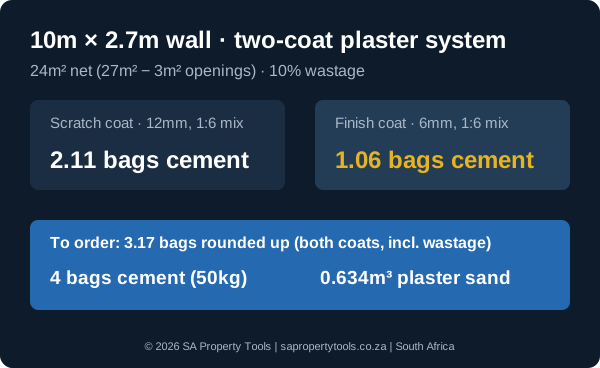
Take a 10m long, 2.7m high internal wall: 27m² gross, minus 3m² of door and window openings, leaving 24m² net. With the two-coat system, the internal 1:6 mix and 10% wastage, the 12mm scratch coat needs 0.317m³ (317 litres) of plaster, which at 150 litres per bag takes 2.11 bags of 50kg cement, and at 200 litres of sand per bag, 0.422m³ of plaster sand. The 6mm finish coat needs 0.158m³, which takes 1.06 bags of cement and 0.211m³ of sand. The two coats together come to 3.17 bags of cement, which rounds up to 4 whole bags, so you order 4 bags of 50kg cement and 0.634m³ of plaster sand for the whole wall. The diagram below sets out the same wall.
Frequently Asked Questions
Both coats together put 18 litres of plaster on each square metre of wall (12mm scratch coat plus 6mm finish coat). For ordering, budget about 1.3 bags of 50kg cement and 0.26m³ of plaster sand per 10m² of internal wall at the Concrete Society of Southern Africa's 1:6 mix, or 1.7 bags and 0.25m³ per 10m² of external or wet-area wall at 1:4.5, both including 10% wastage. Measure the net wall area (length × height, less doors and windows); the calculator above then works out the bags and sand for your own wall.
A scratch coat (also called a render coat or floating coat) is the first layer of plaster, applied at 10–15mm thick. It is keyed (scratched) while still green to provide a mechanical bond for the finish coat. A finish coat is the second layer, applied at 5–8mm thick and trowelled to a smooth surface. Both coats use the same mix, set by where the wall is. The two-coat system is the usual choice in South Africa for external and wet-area walls; a single coat is used on smooth internal masonry.
Use plaster sand (sold as pit sand or fine sand in some regions) for plastering. It has a finer, more consistent grading that produces a smooth, workable plaster mix. Building sand (coarse/angular sand) is used for mortar and brickwork, not plastering. Some SA suppliers label fine-grained plaster sand separately from coarse building sand. Confirm the grading when ordering.
Pick the mix by where the wall is, not by coat. This calculator applies the Concrete Society of Southern Africa's 2024 mixes for common cement: 1:6 (200 litres of plaster sand per 50kg bag) on internal walls and the richer 1:4.5 (150 litres per bag) on external and wet-area walls, for the scratch coat and the finish coat alike. On site, that is one bag to three builder's wheelbarrows of sand (about 65 litres each) for internal plaster, or two and a half for external. Do not add cement to be safe: a richer mix shrinks more and is more likely to crack as it dries. Where an engineer or supplier specifies a mix, follow that instead.
In South African conditions, fresh plaster requires a minimum of 28 days (four weeks) before painting. This allows the alkaline lime and cement chemistry to neutralise sufficiently. Painting too early, even with a primer, can result in alkali attack on the paint film, paint peeling and efflorescence (white salt deposits). During these 28 days, protect the plaster from direct harsh sun and heavy rain.
A typical two-coat system in South Africa is a scratch coat of 10–15mm (this calculator uses 12mm) and a finish coat of 5–8mm (6mm here), about 18mm in all. The Concrete Society of Southern Africa's leaflet Successful plastering (2024) recommends 8–16mm for a first undercoat, 5–8mm for a finish coat and 10–16mm for a single coat, and says a single coat should not be thicker than 16mm, so thicker work is built up in coats. Plaster is specified in SANS 2001-EM1; SANS 10400-K (Walls) refers to that standard and sets no coat thickness of its own.
In South Africa, the terms are often used interchangeably. Traditionally, 'plaster' refers to the interior cement-sand coat on masonry, while 'render' refers to the exterior coat. A rough-plaster or 'plaster and skimcoat' system applies a base coat then a thin finish coat for a smooth surface.
Smooth, dense concrete (such as cast columns, beams or shutter-finished walls) has very low absorption and poor mechanical key for plaster, so a bonding agent (Cemcrete CemBond or similar) or a stipple/spatterdash coat must be applied first and allowed to cure before plastering. Without this step, the plaster will not bond properly and is highly likely to delaminate, particularly on ceilings and soffits where there is no gravity assistance holding the plaster in place.