Brick Calculator, South Africa
Calculate bricks, mortar, cement and sand for any SA wall. Covers maxi, face and stock bricks, single and double skin.
Quick answer: For a single-skin wall, maxi bricks (290×140×90mm) require approximately 33 bricks per m², while standard stock or face bricks (222×106×73mm) require approximately 52 bricks per m². Double-skin walls need double these figures. Always add 5–10% for wastage, cutting and breakage when ordering.
Brick Calculator
Enter Wall Details
For planning purposes only. Consult a registered contractor or quantity surveyor before ordering materials.
How to Use This Calculator
- Use a Quick Start presetClick a Quick Start button to pre-fill typical dimensions for a boundary wall, garage wall, room addition or garden wall, then adjust any field before calculating.
- Enter wall lengthEnter the total length of the wall in metres.
- Enter wall heightEnter the wall height in metres. Standard ceiling height is 2.7m.
- Enter total opening areaEnter the combined area of all doors and windows in square metres. Leave this at zero if there are no openings.
- Select brick typeChoose maxi brick, about 33 bricks per m², or stock or face brick, about 52 bricks per m².
- Select wall typeChoose single skin for one brick wide or double skin for two bricks wide.
- Select brick wastageChoose 10% for most projects, 15% for a complex layout with many openings, or 5% for a simple straight wall. Mortar has its own mix ratio and wastage fields below it: leave them at 1:4 and 10% unless your spec says otherwise.
- Click CalculateResults show total bricks, bricks per m², cement bags and sand volume, based on the mortar mix you chose (1:4 by default).
SA Brick Sizes: What You Need to Know
Getting your brick quantity right before ordering is one of the most important steps in any building project. Order too few and you risk a batch mismatch from the next delivery. Bricks fired in different batches often vary slightly in colour and tone, which is visible on face brick or unpainted work. Order too many and you are paying for material that sits on site. This calculator gives you an accurate starting point based on actual SA brick sizes and a standard 10mm mortar joint.
| Brick Type | Dimensions (L×W×H) | Single Skin per m² | Double Skin per m² | Best Use |
|---|---|---|---|---|
| Maxi Brick | 290×140×90mm | ~33 bricks | ~66 bricks | Load-bearing walls, boundary walls, faster laying |
| Stock Brick | 222×106×73mm | ~52 bricks | ~104 bricks | General construction, plastered walls |
| Face Brick | 222×106×73mm | ~52 bricks | ~104 bricks | Exposed decorative brickwork, no plaster needed |
Coverage rates assume a 10mm mortar joint, the SA standard. Rates include mortar joints both horizontally (bed joints) and vertically (perpend joints).
The Brick Calculation Formula
Net Wall Area (m²) = (Length × Height) − Opening Area
Bricks (no waste) = Net Area × Bricks per m² × Skin multiplier
Bricks (with waste) = Bricks (no waste) × Wastage factor
Mortar volume (m³) = (Net Area × Bricks per m² (single skin) × mortar per brick × Skin multiplier + double-skin collar joint 0.010 m³ per m²) × Mortar wastage
Mortar per brick: maxi 0.000546 m³, stock 0.000323 m³ (10mm joints)
Cement bags (50kg) = Mortar volume × 1.63 ÷ (mix ratio + 1) ÷ 0.033
Sand (m³) = Mortar volume × 1.571 × mix ratio ÷ (mix ratio + 1)
Mortar Quantities for SA Brickwork
Mortar is one of the most underestimated costs in brickwork. Many first-time builders calculate bricks accurately but forget to budget properly for cement and sand. The standard mortar mix for general brickwork in South Africa is 1 part cement to 4 parts building sand (1:4 by volume). For every 1,000 standard stock bricks you should budget approximately:
- About 4 bags of 50kg cement (using 1:4 mix, at the default 10% wastage)
- 0.45 m³ of building sand (0.47 m³ at 15% mortar wastage)
- Important: Use building sand (coarse, angular) not plaster sand (fine, rounded). Plaster sand produces weak mortar
Single Skin vs Double Skin Walls
A single-skin wall is one brick wide, for maxi bricks this is 140mm thick, for stock bricks it is 106mm thick. Single skin is used for internal partition walls, garden walls and boundary walls where structural load is limited. A double-skin wall (also called a cavity wall or solid double-brick wall) is two bricks wide and is used for external walls of habitable rooms in most SA construction, providing better thermal and sound insulation. Double-skin walls use exactly twice the bricks of a single-skin wall of the same face area and a little over twice the mortar, because of the joint between the two skins.
For habitable rooms, SANS 10400 generally requires walls that meet minimum thermal performance standards. In most South African climates, a double-skin brick wall with appropriate cavity treatment satisfies this requirement. Always confirm the wall specification with your architect or building inspector before ordering materials.
Why Brick Prices Vary Across SA Provinces
Brick prices in South Africa vary significantly by province, primarily because of transport costs from manufacturing centres. The Gauteng region has the highest concentration of brick manufacturers and generally the most competitive pricing. KwaZulu-Natal and the Western Cape tend to be 10–20% more expensive due to transport. Always get quotes from at least two local suppliers and confirm whether the price is ex-works (you collect) or delivered to site.
The type of brick also affects price significantly. Stock bricks and maxi bricks are the most affordable and widely available. Face bricks, which require no plastering and are suitable for exposed architectural use, are considerably more expensive, often two to three times the price of a standard stock brick. If you are using face brick for aesthetic reasons, factor this premium into your budget early.
When budgeting for a large brickwork project, also account for wastage. A 5% wastage factor is standard for straightforward rectangular walls; complex shapes, arches, window surrounds and corners typically require 8–10%. Cutting bricks on-site generates waste beyond the bare area calculation. Always round up to the nearest full pallet when placing your order, as returning part-pallets is rarely possible with most SA brick suppliers.
A Worked Example
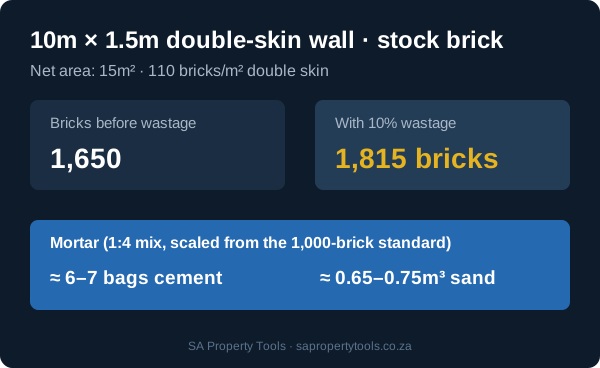
Take a double-skin garden wall, 10m long and 1.5m high, built in stock brick with no doors or windows to deduct. Net wall area is 10 × 1.5 = 15m². At 104 stock bricks per m² for a double skin, the coverage rate from the table above, that is 1,560 bricks before wastage. Add the calculator's recommended 10% wastage (rather than the 5% minimum that only suits a bare rectangular wall with no cuts at all) and you need 1,716 bricks, plus mortar. Working from the brick size and a 10mm joint, the mortar for 1,560 stock bricks plus the joint between the two skins comes to about 0.65m³, or 0.72m³ with the same 10% wastage. Dry cement and sand, with damp sand bulking up, take up about 1.6 times the volume of the wet mix, so at 1:4 that is 8 bags of cement (7.1 before rounding up to whole bags) and 0.90m³ of building sand. Always round your final brick order up to the nearest full pallet, since most SA suppliers will not take part-pallets back.
Want the full build budget, not just brick quantities? Read the Build Cost Planning Guide →
Frequently Asked Questions
For a single-skin wall, maxi bricks (290×140×90mm) require approximately 33 bricks per m², while standard stock or face bricks (222×106×73mm) require approximately 52 bricks per m². For a double-skin wall, double these figures. Always add 5–10% for wastage, cutting and breakage.
Maxi bricks (290×140×90mm) are the largest common SA brick and are used for load-bearing walls and boundary walls, they lay faster and use about the same mortar per m². Stock bricks (222×106×73mm) are the traditional standard size used for most construction. Face bricks are the same size as stock bricks but are fired at a higher temperature for a smoother, more consistent finish suitable for exposed brickwork that will not be plastered.
For every 1,000 standard stock or face bricks (222×106×73mm), you will need approximately 4 bags of 50kg cement and 0.45m³ of building sand using a 1:4 mix ratio at the default 10% mortar wastage (0.47m³ at 15%). For maxi bricks, the mortar volume per 1,000 bricks is higher because each brick is larger. Budget approximately 6 bags of cement and 0.75m³ of sand per 1,000 bricks at 10% mortar wastage (7 bags and 0.79m³ at 15%).
A typical 3-bedroom house of 120–150m² floor area with a wall height of 2.7m and a perimeter of approximately 50m requires roughly 15,000–20,000 bricks in total once internal walls are added to the external single-skin walls. External walls alone (perimeter × height × bricks/m²) account for only around 7,000–8,000 of that. Double-skin sections, openings for doors and windows and gable ends all affect the final count. Always have a quantity surveyor verify the figure before ordering.
This calculator calculates its mortar quantities on a 1:4 mix by default (1 part cement to 4 parts building sand by volume), the Concrete Society of Southern Africa's Class I mortar, and lets you pick 1:3 or 1:6 instead. Class II, about 1:6 (200 litres of sand per 50kg bag), is the mortar SANS 10400-K names for masonry walls and the Society says it is used for most applications, so it suits ordinary house and garden walls. Class I is for highly stressed masonry or where specified. A richer 1:3 mix is only used where specified. Do not use builder's sand (plaster sand) in mortar. Use building sand with angular particles for proper bond strength.
Yes, always add a minimum of 10% wastage to your calculated brick quantity. This accounts for cutting around door and window openings, broken bricks during delivery and laying and pattern cuts at corners and ends. For complex designs with many openings or features, increase wastage to 15%. It is always cheaper to over-order slightly than to try to match bricks from a different batch later.
The most common SA brick is 222mm × 106mm × 73mm (standard stock or face brick). Maxi bricks are larger at 290mm × 140mm × 90mm and lay faster. Always confirm the exact size with your supplier before calculating quantities, as minor dimensional variations exist between manufacturers.
Stock brick prices range from approximately R2.00–R5.50 per brick depending on region and supplier. Face bricks cost R5.00–R18.00 per brick. Prices vary significantly by province. KZN and Gauteng are generally cheaper than Western Cape. Always get quotes from at least two local suppliers.
The Quick Start buttons pre-fill typical SA dimensions and wall type for four common projects: a boundary wall (10m long, 1.8m high, single skin), a garage wall (6m long, 2.4m high, double skin, with an allowance for a side door), a room addition (a 4m × 4m room's external walls, double skin, with an allowance for a door and window) and a garden wall (10m long, 1.5m high, double skin). Each preset calculates instantly, and every field stays editable afterwards, so you can adjust the length, height or any other input to match your actual project before ordering.