Cable Size Calculator: South Africa
Find the correct cable size for any SA circuit. Checks current carrying capacity and voltage drop against SANS 10142 requirements.
Quick answer: A 3kW geyser on a 230V single-phase supply draws approximately 13A. A 2.5mm² copper cable is typically enough at the standard 30°C reference, but SANS 10142's ambient temperature derating factors mean a hot roof space (50-60°C, common in SA summers) can push the real requirement up to 4mm². Check your specific installation with the calculator's Ambient Temperature input below.
Cable Size Calculator
SANS 10142 capacity tables, 5% maximum voltage drop
Quick Fill: Common Circuits
⚠️ For planning purposes only. All electrical work in SA must be carried out by a registered electrician under SANS 10142. A Certificate of Compliance (CoC) is required.
How to Use This Calculator
- Enter load as watts or ampsSwitch to Watts and enter the appliance power from its nameplate, or switch to Amps and enter the circuit current from your DB board.
- Select supply voltage230V for single-phase, standard in most SA homes, or 400V for three-phase supplies.
- Enter one-way cable runDB board to load point in metres. One-way only, used to check voltage drop over the full circuit.
- Select installation methodClipped-direct or surface-mounted cable runs cooler and carries more current than the same cable in conduit.
- Select ambient temperatureSA roof spaces regularly exceed 40 to 50 degrees Celsius in summer, especially relevant for geyser and solar cabling.
- Select cables grouped togetherMultiple loaded cables sharing a conduit or tray heat each other, so each needs a lower rating.
- Click Calculate Cable SizeResults show the minimum compliant cable size, checked against both SANS 10142 current capacity and voltage drop requirements.
Cable Sizing in South Africa: SANS 10142 Explained
Selecting the correct cable size is one of the most critical steps in any electrical installation. An undersized cable overheats, degrades insulation, creates a fire risk and will fail a Certificate of Compliance (CoC) inspection. Oversizing wastes money unnecessarily. SANS 10142, South Africa's wiring code, specifies exactly how cable sizing must be done.
There are two separate tests a cable must pass under SANS 10142, and both must be satisfied independently. This calculator checks both automatically.
The Two SANS 10142 Cable Sizing Checks
Check 1: Current Carrying Capacity
Every cable has a maximum continuous current it can carry safely without the insulation overheating. For standard copper PVC-insulated cables at 70°C operating temperature, these are the rated values used in South Africa:
| Cable Size | Clipped Direct (A) | In Conduit (A) | Volt Drop single-phase (mV/A/m) | Volt Drop three-phase (mV/A/m) | Typical Use |
|---|---|---|---|---|---|
| 1.5mm² | 19.5A | 16.5A | 29 | 25 | Lighting circuits |
| 2.5mm² | 27A | 23A | 18 | 15 | Plugs, geysers (short runs) |
| 4mm² | 36A | 30A | 11 | 9.5 | Geysers, cooktops (short runs) |
| 6mm² | 46A | 38A | 7.3 | 6.4 | Stoves, pool pumps |
| 10mm² | 63A | 52A | 4.4 | 3.8 | Large stoves, sub-mains |
| 16mm² | 85A | 69A | 2.8 | 2.4 | Sub-distribution boards |
| 25mm² | 112A | 90A | 1.75 | 1.50 | Main DB feeds |
| 35mm² | 138A | 111A | 1.25 | 1.10 | Main supply cables |
Source: SANS 10142-1:2021 (Edition 3.1) Table 6.3(a) (current-carrying capacity) and Table 6.3(b) (voltage drop), multicore PVC-insulated unarmoured copper cable, 70°C conductor temperature, 30°C ambient. Current figures are for one two-core cable on a single-phase circuit, clipped direct (installation method 3) and in conduit on a wall or ceiling or in trunking (method 2); a three-core or four-core cable on a three-phase circuit carries less (2.5mm² clipped: 24A) and the calculator uses those figures for 400V. Conduit enclosed in an insulating wall (method 1) carries less again (2.5mm²: 18.5A).
Check 2: Voltage Drop
Even if a cable can carry the current safely, it must not drop too much voltage along its length. SANS 10142 sets the maximum voltage drop at 5% of the supply voltage for final circuits:
- 230V single phase: Maximum 11.5V drop
- 400V three phase: Maximum 20V drop
Current (A) = Power (W) ÷ Voltage (V) [single phase]
Current (A) = Power (W) ÷ (400 × 1.732) [three phase]
Voltage Drop (V) = mV/A/m × Current (A) × Length (m) ÷ 1000
mV/A/m: from the standard's single-phase and three-phase columns (Table 6.3(b))
VD % = Voltage Drop (V) ÷ Supply Voltage (V) × 100
SANS 10142 limit = 5% of supply voltage (11.5V / 20V)
Why Installation Method Matters
A cable installed in conduit or enclosed trunking cannot dissipate heat as efficiently as one clipped to a surface or run in open air. This means the same cable has a lower current rating in conduit than when surface-mounted. The SANS 10142 derating for conduit is significant: a 2.5mm² cable drops from 27A (clipped direct) to 23A (in conduit on a wall or in trunking), and to 18.5A where the conduit is enclosed in an insulating wall (SANS 10142-1 Table 6.3(a), installation methods 3, 2 and 1). The calculator uses the conduit-on-a-wall figure. Failing to apply this derating results in overloaded cables that overheat and degrade.
Common SA Circuit Examples
These are typical cable sizes used in South African residential installations. Always verify with a registered electrician, as actual installations depend on run length, grouping and ambient temperature.
- Lighting circuits: 1.5mm² (up to 20m runs), 2.5mm² for longer runs
- 15A plug circuits: 2.5mm² (short runs), 4mm² (over 25m)
- Geyser 3kW: 2.5mm² at standard 30°C conditions, 4mm² in a hot roof space (50–60°C, common in SA)
- Electric stove 6–9kW: 6mm² minimum, 10mm² for longer runs
- Air conditioner 3–5kW: 2.5mm² (short runs), 4mm² (over 15m)
- DB board sub-mains: 10mm²–25mm² depending on total load
- Inverter / solar feed: 10mm²–25mm² depending on inverter size and run length
Ambient Temperature Derating, Critical in South African Conditions
The current-carrying capacity values in SANS 10142 assume an ambient temperature of 30°C. In South African conditions, roof spaces in summer, industrial environments and direct-sun surface installations, ambient temperatures frequently exceed 40°C, which meaningfully reduces cable capacity. SANS 10142-1 Table 6.10 gives these ambient temperature correction factors for general-purpose 70°C PVC-insulated cable: 0.94 at 35°C, 0.87 at 40°C, 0.79 at 45°C, 0.71 at 50°C, 0.61 at 55°C and 0.50 at 60°C. A 2.5mm² cable rated at 27A clipped direct at 30°C is limited to about 19.2A in a 50°C roof space and to 13.5A at 60°C, only just above a standard 3kW geyser's 13A draw; in conduit (23A) it falls to 11.5A at 60°C, below that draw. Use the calculator's Ambient Temperature input above to apply the correct factor directly, particularly for geyser circuits and solar panel DC cabling installed in enclosed roof voids.
Grouping Derating, When Cables Run Together
When multiple current-carrying cables are bundled or run in close contact, the combined heat from adjacent cables reduces each cable’s individual capacity. SANS 10142-1 Table 6.14 gives these grouping correction factors for cables enclosed in conduit or trunking, or bunched and clipped direct to a non-metallic surface: 0.80 for 2 circuits, 0.70 for 3, 0.65 for 4, 0.60 for 5 and 0.57 for 6, falling further for larger groups (0.52 for 8, 0.48 for 10). This is particularly relevant in South African installations where multiple circuits are routed in a single conduit or cable tray between the DB board and distribution points. A 2.5mm² cable carrying 20A in a conduit is safely loaded when run alone but may be overloaded when sharing the conduit with two other loaded circuits. Use the calculator's Cables Grouped Together input above to apply the correct factor, alongside ambient temperature, since both derating effects combine and neither substitutes for the other.
A Worked Example: Why Roof-Space Heat Changes the Answer
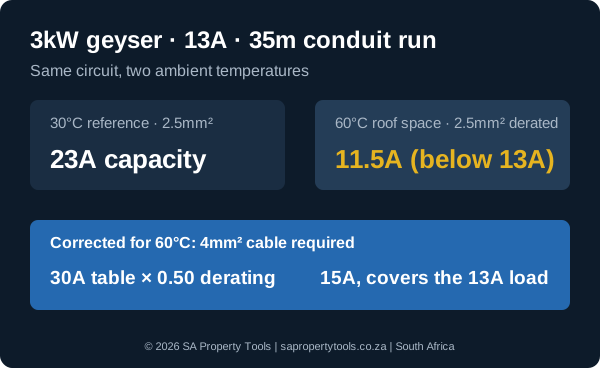
A standard 3kW geyser draws about 13A at 230V. For a 35m run in conduit (a larger home, geyser well away from the DB board), a 2.5mm² cable at the standard 30°C reference has a 23A capacity, comfortably enough, and passes voltage drop too (8.2V against the 11.5V limit). But geyser cabling almost always runs through a roof space, and South African roof spaces regularly exceed 50–60°C in summer. At 60°C the ambient correction factor is 0.50, cutting that 23A rating to 11.5A, below the geyser's 13A draw and no longer compliant. A 4mm² cable, rated 30A in conduit, derates to 15A at the same 60°C, covering the load, and drops 5.0V over the 35m. This is why many SA installers default straight to 4mm² for geyser circuits: not because 2.5mm² fails under standard test conditions, but because it can fail once real roof-space heat is properly accounted for. Run this exact scenario through the calculator above (3000W, 230V, 35m, in conduit) at 30°C and then again at 60°C to see the recommendation change from 2.5mm² to 4mm². If it is clipped direct instead of in conduit, a 2.5mm² cable is rated 27A and still just passes at 60°C (13.5A), with 0.5A to spare, so any further derating such as a second cable alongside it tips it over.
Frequently Asked Questions
A 3kW geyser on a 230V single-phase supply draws approximately 13A. A 2.5mm² copper cable meets both the current-capacity and voltage-drop requirements at the standard 30°C reference for a typical run, but geyser cabling is almost always routed through a roof space, and SANS 10142's ambient temperature derating means a 2.5mm² cable can fall below the required capacity once real roof-space heat (50-60°C in SA summers) is accounted for. Many installers default to 4mm² for this reason. Use this calculator's Ambient Temperature input to check your specific installation, and always use a dedicated circuit with a 20A breaker for a geyser.
A typical 6–9kW electric stove on a 230V single-phase supply draws 26–39A. This requires a minimum 6mm² cable for short runs, or 10mm² for longer runs. Most stoves are installed on a dedicated 40A circuit. Always confirm the stove's rated current on the nameplate and size the cable accordingly with a registered electrician.
Cable sizing in SA involves two checks under SANS 10142: (1) Current carrying capacity: the cable must carry the full load current without overheating. (2) Voltage drop: the voltage lost along the cable must not exceed 5% of the supply voltage (11.5V for 230V single-phase, 20V for 400V three-phase). The formula is: Current (A) = Power (W) ÷ Voltage (V) for single phase. Then select the smallest cable whose rated current exceeds your load current AND whose voltage drop stays within limits.
SANS 10142 is the South African National Standard for the wiring of premises, the code that registered electricians must follow. It specifies minimum cable sizes, voltage drop limits, breaker sizing, earthing requirements and installation methods. Using undersized cable is a safety hazard and a legal non-compliance issue that will fail a Certificate of Compliance (CoC) inspection.
SANS 10142 specifies a maximum voltage drop of 5% of the nominal supply voltage for final circuits. This is 11.5V on a 230V single-phase supply and 20V on a 400V three-phase supply. Exceeding this causes equipment to underperform, motors to overheat and lights to dim, and it will fail a CoC inspection.
Under South African law (Electrical Installation Regulations 2009), all electrical work must be carried out or supervised by a registered person, a wireman's licence holder or electrician registered with the Department of Employment and Labour. DIY electrical work is illegal and will not receive a Certificate of Compliance (CoC), which is required when selling a property. This calculator is a planning tool only. Always use a registered electrician for installation.